EVANSVILLE, IN – Youth First is celebrating Deaconess Health System for investing in Indiana youth. The organization recently awarded $17,500 to Youth First, Inc. to strengthen the mental health and well-being of students in Youth First partner schools across Gibson, Posey, Vanderburgh and Warrick counties.
This significant gift from Deaconess, along with funding from other sources, will enable Youth First to provide its school-based student assistance program and family and community prevention programs to help students build valuable life skills and healthy mindsets as they grow into thriving adults.
“Deaconess Health System believes in making a positive difference in the lives of our patients, families, employees and community. We support Youth First because positive outcomes show their mental health professionals and prevention programs are truly building more healthy, resilient kids,” stated Jackie Stinson-Smith, Deaconess Health System’s Chief Administrative Officer and Behavioral Health Center of Excellence Systems Director.
Youth First embeds highly trained mental health professionals in school buildings, partnering with 125 schools across 14 Indiana counties. Youth First Mental Health Professionals build caring relationships, promote healthy choices, foster readiness for positive change, and boost resiliency along with other valuable life skills.
Youth First President & CEO Parri Black shared, “Our kids and families are dealing with busier schedules, greater stress and more complex challenges than ever. That’s why it’s so important to have easy access to skilled mental health support in school buildings, where students, parents and teachers can take full advantage of it. We are grateful for a continued partnership with Deaconess Health System to build strong futures for Indiana kids.”
https://youthfirstinc.org/wp-content/uploads/2025/12/Deaconess-Cropped-Check-Presentation-1-March-3-2025-scaled.jpg14562560Youth Firsthttps://youthfirstinc.org/wp-content/uploads/2017/06/340x156_YouthFirst_logo_color-300x138.pngYouth First2025-03-27 15:13:132025-12-11 15:20:46Deaconess Health System Awards $17,500 to Youth First
When I turned 40, someone told me that your forties are one of the most stressful times in your life. For many, your twenties and thirties often revolve around graduating from college, buying your first home, getting married, having kids, landing a good job, etc.
This means you and/or your friends are attending many celebratory events – bridal showers, housewarmings, baby showers, birthday parties, and enjoying all of those firsts. You are still spending a lot of time with friends and family.
Often when you enter your forties, you are raising kids who are still under the age of 18, working to earn a paycheck to support your family and paying bills (which include house and car payments, insurance, and daily living expenses), which often leads to less socializing and gathering with friends. To add to these responsibilities, sometimes individuals in their forties also have the added responsibility of taking care of their parents in one way or another.
This is where the “sandwich generation” comes into play. I personally did not know this was a thing, but I went to dear old Google to check it out.
According to an article from the Department of Psychiatry at the University of Michigan, the sandwich generation refers to a middle-aged group of Americans who serve as caregivers for both older and younger family members at once. The article states that there are over 2.5 million individuals who fit into the sandwich generation.
An article from USA Today stated that, “A growing share of the sandwich generation are millennials, adults born between 1981 and 1996.” An article in seniorliving.org pointed out that, “More than 50 percent of Americans in their forties are now taking care of both their children and senior parents.”
It is hard to juggle a full-time job and care for your children and aging parents. Essentially in one day, you could be transferring a parent into a nursing home, taking your teenager to get their license, attending a program for your preschooler, and trying to work eight hours at your job. This is stressful physically, emotionally, and financially.
An article written by Barbara Field on caregiver.org stated that with so many stressors, over 35 percent of caregivers experience feelings of depression. She noted that the sandwich generation can often experience:
Caregiver burnout and feelings of guilt and isolation
Excessive rumination about not being a good spouse, parent, or child due to limited time constraints
Trouble juggling work, hobbies, relationships, and self-care
Psychological challenges as they struggle with being pulled in multiple directions
I chose to write this article because before my dad passed away, I was part of the sandwich generation, and I have no doubt that with a 2-year-old and a teenager I will be part of it again.
The most important thing I learned so far on my journey is to ask for help, which is sometimes easier said than done. Your well is only so deep, and once it is depleted you are no help to anyone. Asking for help could mean finding someone else to transport your kids to practice or scouts. Ask your older kids and/or spouse to help out more around the house.
It could also mean talking to a therapist about your mental health or joining a support group. It might include saying a prayer and asking for guidance. Even just having a friend you can vent to can be helpful.
Here are some other tips to take care of yourself while you are busy taking care of others:
Manage expectations, self-criticism, and perfectionist tendencies.
Look for small wins — positive things that happened in the day.
Make time for things you enjoy, whether it’s reading a book, taking a walk, or watching your favorite TV show
Get plenty of sleep
Pay attention to what you eat to fuel your body. If you are only eating drive-thru or gas station food, it will take a toll on your health.
The bottom line is to take care of yourself while you’re taking care of others. As the saying goes, “You can’t pour from an empty cup.” You’ll be a better caregiver if you take time to nourish your mind, body and soul first.
https://youthfirstinc.org/wp-content/uploads/2025/03/Three-generations-Sandwich-generation-scaled.jpg17072560Youth Firsthttps://youthfirstinc.org/wp-content/uploads/2017/06/340x156_YouthFirst_logo_color-300x138.pngYouth First2025-03-27 14:57:482025-03-27 14:58:30Are You Part of the Sandwich Generation?
“D-Patrick Ford Cares” continues its support of local charities and positive causes.
D-Patrick Ford/Lincoln presented a check for $2,500 to Youth First on Friday, March 21, at 3 pm. The presentation was at the D-Patrick Ford/Lincoln dealership, located at 1100 Walnut Street just south of the Highway 41/Lloyd Expressway Interchange. General Manager Peter O’Daniel and General Sales Manager Cody Staffelbach from D-Patrick Ford/Lincoln were present the check to representatives from Youth First.
Each month, as a part of its ongoing ‘D-Patrick Ford Cares’ program, D-Patrick Ford/Lincoln selects a local charity or community enhancement organization to support. It then awards $2,500 to the organization in support of its programs.
https://youthfirstinc.org/wp-content/uploads/2025/03/D-Patrick-Ford-Cares_Names-Youth-First-Charity-of-the-Month_March-2025.jpg14401920Youth Firsthttps://youthfirstinc.org/wp-content/uploads/2017/06/340x156_YouthFirst_logo_color-300x138.pngYouth First2025-03-27 11:48:352025-12-11 15:23:53D-Patrick Ford/Lincoln presents a $2,500 donation check to Youth First
The DSM (Diagnostic and Statistical Manual of Mental Disorders) classifies substance use disorder as a medical illness that can be characterized by impairments to health, social functions, and voluntary control over substance use.
People are often intimidated by the topic of substance use and addiction, as it can be a scary topic to broach. However, it is crucial for parents to begin talking to their children about this as early as possible. Parents should have a strong relationship with their children early on to be able to address this heavy topic openly. It is beneficial to learn strategies to show them what to do instead of what they should not do.
In order to effectively address addiction, it is important that parents and children understand that everyone is at risk for addiction. Children and teens will often operate under the impression that addiction cannot happen to them because they believe the stereotypes that come with it.
Addiction is not something that people plan for; it can happen after just trying something that ends up altering their brain chemistry. Many younger people may also believe that they are invincible or the substances are a harmless way to have fun. What they do not understand is that these substances are physically altering the way their brains are developing if they try them at a young age.
Parents play a critical role in prevention of substance misuse, as they are often their children’s most influential role models. Actions are more important than words in most cases, and this is extremely important to model here. It is crucial for parents to model healthy coping skills when life is hard. For example, if a parent has had a rough day, it would be more beneficial for the child to see them go for a walk to cope with that rather than having multiple drinks.
If you do choose to turn to a substance, children should see that you are doing it in a healthy amount and not as an escape. Children need healthy escape strategies, such as mindfulness, rather than ones that could lead to a dangerous path. A great example of a positive mindfulness escape could be a strategy where all of the senses are utilized to distract the child from what is causing them stress. By teaching mindfulness strategies and other positive coping skills, parents can foster a safe environment where a child feels comfortable expressing themselves in healthy ways instead of turning to substances.
Children might need assistance in learning boundaries in order to keep them safe. Boundaries are extremely important for kids to learn early on, and they will be extremely helpful to aid them in prevention. Giving children boundaries and teaching them how to set boundaries with others will help them stand strong when they are put in a difficult situation on the spot. The types of friendships that they choose are crucial to being able to set boundaries and avoid temptation.
Ensuring that your children are making good friends can be critical to the path they end up taking. They are influenced by their friends just as they are influenced by the media. Substance abuse exposure can easily begin to add up by exposure on social media, their friends, in their music, by their parents, and on TV. Do not be fooled by thinking this exposure is normal for teens.
Early intervention can be provided in various settings. It is important that children are exposed to early intervention in order for them to understand and keep them on the right track. Do not underestimate addiction or think that it will never happen to your family. Act now and provide your child with necessary life skills.
https://youthfirstinc.org/wp-content/uploads/2025/03/AA-teen-surrounded-by-pills-scaled.jpg25601707Youth Firsthttps://youthfirstinc.org/wp-content/uploads/2017/06/340x156_YouthFirst_logo_color-300x138.pngYouth First2025-03-20 09:58:452025-03-20 09:58:47Parents Play a Critical Role in Substance Misuse Prevention
Grant to Provide Expanded Mental Health Support and Substance Misuse Prevention for Morgan County Youth
March 18, 2025 –
Franciscan Health Foundation, through their Social Impact Partnership Program (SIPP), has awarded $10,000 to Youth First, Inc., to invest in the health and well-being of Morgan County youth and families. The award will provide mental health support and substance misuse prevention through social work services and prevention programs at Mooresville High School and Paul Hadley Middle School.
The Social Impact Partnership Program seeks to partner with community organizations in an effort to improve health and well-being. By working towards meaningful and sustainable change, community residents will be empowered to take better care of themselves and their families.
Danielle Crowder, Director, Franciscan Health Community Health Improvement, states: “Franciscan Health is eager to partner with Youth First, Inc. for our Ministry’s 2024-2025 Social Impact Partnership (SIPP) cycle. Aligning Morgan County youth and families with mental wellness protective factors to reduce and heal generational trauma is one of our Ministry’s top priorities. We look forward to collaborating with Youth First, Inc. to create a healthier Morgan County for years to come.”
The grant to Youth First will allow for continued mental health support for students in selected Martinsville and Mooresville schools. Youth First partners with 126 schools across 14 Indiana counties to embed prevention programs and over 100 skilled mental health professionals (primarily master’s level social workers) in school buildings, where they provide caring mental health support for students and prevention coaching for parents and teachers. Youth First Mental Health Professionals build caring relationships, foster readiness for positive change, and boost resiliency, along with other valuable life skills.
Research shows these protective factors are the keys to effective prevention of negative outcomes for young people. The organization’s positive work and strategies are driving growth, with more schools seeking Youth First’s help to address the growing need for mental health support for students.
https://youthfirstinc.org/wp-content/uploads/2025/03/FranciscanHealthLogoTo255x255-002-002.jpg255255Youth Firsthttps://youthfirstinc.org/wp-content/uploads/2017/06/340x156_YouthFirst_logo_color-300x138.pngYouth First2025-03-18 12:17:322025-03-18 12:19:38Franciscan Health Foundation Awards $10,000 to Youth First
Any adult will tell you it is taboo to discuss religion or politics. This is easy enough, so long as you do not parent or educate children.
I was unprepared when my six-year-old forcefully stated his personal political opinions in response to the television news playing in the crowded waiting room of his dentist’s office.
For those raising and educating children, maintaining the polite status quo is not an option. It is our responsibility to create a safe space for them to talk about whatever is on their mind and to help them develop the skills to speak their minds in a thoughtful and respectful manner (when it is appropriate, of course).
But how?
Start where they are. What do they know, what have they heard, what questions do they have? This gives you the best jumping off point and allows you an opportunity to correct misinformation and discuss the importance of where information comes from. Let them guide the conversations. This makes them feel safe and heard. When children feel heard by their adults, they develop trust and are more likely to share the hard things that arise in the future.
Use simple and neutral explanations. Stick to the facts. While I do hope my children grow up to share my beliefs, I know it is best if they arrive there on their own, and their journey may include detours. Allow them the space to explore. Children learn best when trusted adults model their personal values and critical thinking rather than dictating.
Validate their feelings. As parents, the desire to pave a smooth road for our children is strong. This is simply not feasible and does not create resilience. Reminding them that their feelings are valid gives them the space to process their feelings and then the ability to think about their next steps.
Explain processes rather than specifics. Educating children about the workings of government and democracy allows them a sense of empowerment. You can further empower them by helping them get involved by doing things like writing letters, attending local events, or even discussing issues with others (in appropriate settings, of course).
Focus on values. Remind them that, for the most part, humans share the same values: autonomy and accountability, achievement and altruism, wealth, freedom, and fairness, but we all prioritize these values differently. The difference in how we prioritize values is what results in our political differences. It is dismissive and harmful to believe opposing sides lack essential values.
Model kindness, respect, and curiosity. When engaging those with differing views, encourage curiosity over persuading. Asking others about their different beliefs is a far more effective way of engaging. Preaching on the other hand, often reinforces an opponent’s beliefs.
By following these steps, you can help your child learn to prioritize their values and discuss their thoughts and opinions in a calm, respectful manner. It is important for them to learn to listen to others with curiosity when they have differing beliefs and opinions.
https://youthfirstinc.org/wp-content/uploads/2025/03/Child-giving-a-speech-scaled.jpg17082560Youth Firsthttps://youthfirstinc.org/wp-content/uploads/2017/06/340x156_YouthFirst_logo_color-300x138.pngYouth First2025-03-17 14:22:112025-03-17 14:24:10Teaching Your Child to State Their Opinion in a Thoughtful Manner
Gift to Provide Mental Health Support for Students at Washington Community Schools and Washington Catholic Schools
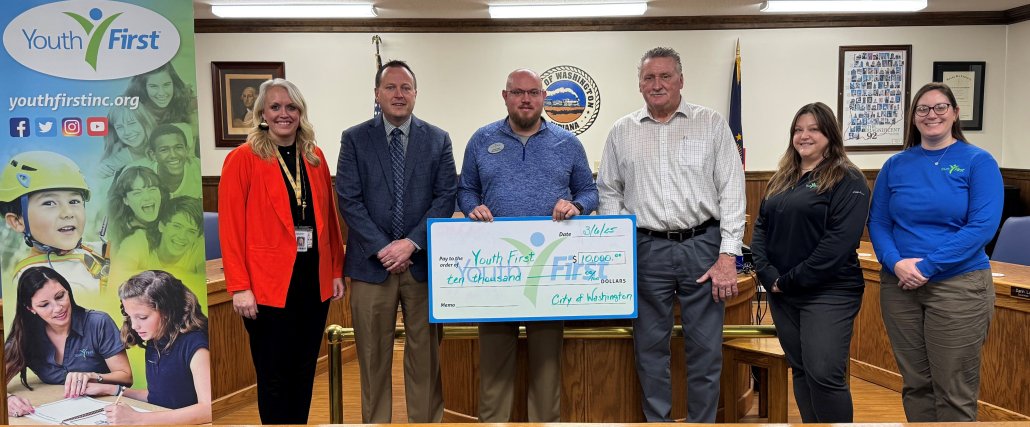
Youth First is celebrating the City of Washington for investing in Daviess County youth. The city recently awarded $10,000 to Youth First, Inc. to strengthen the mental health and well-being of students in Youth First partner schools in the Washington Community School Corporation and Washington Catholic Schools.
This significant gift from the City of Washington, along with funding from other sources, will enable Youth First to provide its school-based student assistance program and family and community prevention programs to help students build valuable life skills and healthy mindsets as they grow into thriving adults.
Kevin Frank, Superintendent of Washington Community Schools, stated: “On behalf of our schools, I sincerely thank Mayor Rhoads and the City of Washington town council for its generous financial support to help fund our Youth First Social Workers. This investment in our students’ well-being will make a lasting impact, ensuring they receive the social and emotional support they need to thrive.”
Youth First embeds highly trained mental health professionals in school buildings, partnering with 126 schools across 14 Indiana counties. Youth First Mental Health Professionals build caring relationships, promote healthy choices, foster readiness for positive change, and boost resiliency along with other valuable life skills.
“It is very important to have Youth First in our schools and to be able to provide assistance to students, which is truly valuable to both the student and the community. The City of Washington is glad to invest in our students’ future success,” said David Rhoads, Mayor, City of Washington.
https://youthfirstinc.org/wp-content/uploads/2025/03/City-of-Washington-Cropped-Check-Presentation-March-2025-scaled.jpg10622560Youth Firsthttps://youthfirstinc.org/wp-content/uploads/2017/06/340x156_YouthFirst_logo_color-300x138.pngYouth First2025-03-07 14:48:272025-03-07 14:52:42City of Washington Awards $10,000 to Youth First
In a school setting, social workers play a vital role in supporting students’ academic, emotional, and social development. One of the most crucial aspects of this role is fostering and maintaining healthy relationships with these students.
These relationships serve as the foundation for effective intervention, building trust, and long-term positive outcomes for students. Students who have healthy relationships with their school social worker can overall have a more successful school experience by feeling a sense of safety, connection, and support, especially for those navigating challenges at home, in the classroom, or within their peer groups.
First, trust is the beginning of any effective relationship between a social worker and a student. Many students who seek the support of a social worker are dealing with sensitive issues such as family instability, mental health struggles, bullying, or academic stress.
By building a trusting relationship, social workers create a safe space where students feel comfortable expressing their emotions and concerns. Trusting their school social worker allows students to share and be more vulnerable without fear of judgment, which allows the social worker to provide meaningful and personalized support. Without building this trust, students may withhold information, making it difficult to meet their needs.
Healthy relationships with students also promote emotional resilience and self-esteem. Social workers serve as positive role models and offer encouragement for students who may lack support in other areas of their lives. By showing empathy and understanding, social workers help students develop a sense of self-worth and confidence in their ability to overcome new challenges. This can then foster a more positive self-concept, which is essential for academic success and socializing with peers.
Maintaining strong relationships between social workers and students enhances the effectiveness of interventions aimed at improving academics and behavior. When students feel understood and valued, they are more likely to participate in the goal-setting process and follow through on set action plans. For example, a student struggling with truancy may respond better to a social worker who has taken the time to understand the causes of absenteeism, such as anxiety or family dynamics, instead of enforcing disciplinary actions. By building rapport, the social worker can address the root cause of the issue and provide solutions.
In addition, healthy relationships with students contribute to a more supportive school environment. Social workers serve as advocates for students, ensuring their voices are heard and their needs are met. By fostering genuine connections, social workers gain insight into the challenges faced by individuals and groups, such as marginalized or at-risk populations. This understanding allows social workers to implement programs that promote equity, cultural competence, and a sense of belonging for all students.
Lastly, the benefits of healthy relationships between social workers and students extend beyond the school setting. Social workers often work with students on life skills such as emotional regulation, conflict resolution, and decision-making, which are essential for success as an adult. By modeling positive relationships and providing consistent support, social workers teach students how to create and maintain healthy connections with others, which is essential for future interpersonal success. In conclusion, maintaining healthy relationships with students is an important part of effective social work in schools. These relationships foster trust, promote emotional well-being, improve interventions, and create a positive and inclusive school environment. By maintaining genuine connections with students, school social workers can make a lasting impact on students by helping them succeed both academically and personally.
https://youthfirstinc.org/wp-content/uploads/2025/03/Male-social-worker-talking-with-boy-scaled.jpg17072560Youth Firsthttps://youthfirstinc.org/wp-content/uploads/2017/06/340x156_YouthFirst_logo_color-300x138.pngYouth First2025-03-06 09:32:582025-03-06 09:38:48Students Benefit from Having a Trusted Adult in the School Building