• Español Familias
Youth First
  • About
    • Who We Are
      • Mission, Vision & Values
      • Outcomes & Impact
      • Stories of Change
      • History
      • Team
      • Youth First Mental Health Professionals
      • Board of Directors
      • Leading Sponsors
    • Where We Are
      • Catholic Diocese of Evansville
      • Daviess
      • Dubois
      • Gibson
      • Greene
      • Knox
      • Lawrence
      • Martin
      • Monroe
      • Morgan
      • Orange
      • Perry
      • Posey
      • Spencer
      • Vanderburgh
      • Warrick
  • Programs
    • For Schools & Students
      • Youth First Mental Health Professionals
      • Al’s Pals
      • C.A.S.T.
      • LifeSkills Training
      • Reconnecting Youth
      • Teen Series
      • Tween Series
      • WhyTry
    • For Families & Youth
      • Camp Memories
      • Family First
      • Family Foundations
      • In It to Win It
    • For Communities
      • Talk – They Hear You
      • The Truth Is
  • Resources
    • Resiliency Resources
    • Advice from Our Professionals
    • Other Helpful Resources
  • News
    • Newsletter
    • News Releases
  • Events
    • Calendar of Events/Programs
    • Youth First Warrick County Golf Scramble
    • Youth First Breakfast of Champions
    • Youth First Benefit Auction
  • Careers
  • Contact
  • Support
    • Donate
    • Volunteer
  • Click to open the search input field Click to open the search input field Search
  • Menu Menu
  • Link to Facebook
  • Link to Instagram
  • Link to Youtube
  • Link to LinkedIn

Managing Stress in the Elementary Classroom

All Posts, Counties, Youth First Blog

By Kelly Leavitt, MSW, LSW – August 26, 2026 –

Have you ever wondered how stress affects an entire school classroom? What steps can we take to manage stress before it becomes overwhelming? And how can educators recognize stress in students and help them cope?

Students today are influenced by their peers in both positive and negative ways. Because elementary-aged children are still developing the skills needed to identify and manage their emotions, creating a supportive school environment is essential. When stress becomes overwhelming, it can affect a student’s academic performance, relationships, comfort, and overall well-being.

Children may experience stress for many reasons, including academic expectations, extracurricular activities, learning challenges, peer conflicts, and difficulties at home. At this age, many students have difficulty identifying the source of their stress, making it especially important for adults to recognize changes in their behavior and emotional well-being.

Educators can experience significant stress as well. High levels of workplace stress may contribute to burnout, decreased job satisfaction, and staff turnover. When teachers are overwhelmed, they may have less emotional energy to provide the support, stability, and structure students need. Supporting educators is therefore an important part of creating a healthy classroom environment.

Recognizing signs of stress is the first step toward helping students manage it. Warning signs may include irritability or agitation, extreme mood changes, difficulty concentrating or making decisions, withdrawal from friends or family, changes in eating or sleeping habits, declining school performance, poor self-esteem, impulsive behavior, or persistent feelings of sadness or hopelessness. When these changes are noticeable or ongoing, trusted adults need to respond with patience and support.

There are several ways schools can help students manage stress. Physical activity can provide an opportunity to release tension and improve mood. Incorporating movement breaks, outdoor activities, or physical education into the school day can support students’ emotional well-being. Mindfulness activities, such as deep breathing, guided meditation, or brief moments of quiet reflection, can also help students recognize and regulate their emotions.

Creating strong social connections is equally important. A classroom where students feel safe, supported, and connected to their teachers and peers can provide a valuable buffer against stress. Encouraging positive relationships, teaching coping skills, and creating opportunities for students to communicate their feelings can help them develop healthy ways to manage challenges.

Teachers also need opportunities to manage their own stress. Self-care, professional development, peer support, and access to appropriate wellness resources can help educators maintain their well-being. A supportive network of colleagues can provide a space to share challenges, exchange ideas, and learn effective coping strategies.

By prioritizing stress management for both students and educators, schools can create environments that promote emotional well-being and academic success. When stress continues despite consistent support and coping strategies, seeking assistance from a qualified mental health professional may provide additional resources and support.

Kelly Leavitt, MSW, LSW, is a Youth First Mental Health Professional at Highland Elementary School in Vanderburgh County. Youth First, Inc., is a nonprofit dedicated to strengthening youth and families. Youth First provides over 100 highly trained mental health professionals (primarily master’s level social workers), prevention programs, parent engagement coordinators, and bilingual support personnel to 138 schools across 15 Indiana counties. Over 56,000 youth and families each year are served by Youth First’s school-based social work and community programs that promote mental health, prevent substance misuse, and maximize student success. To learn more about Youth First, visit youthfirstinc.org or call 812-421-8336.

August 26, 2026/by Youth First
https://youthfirstinc.org/wp-content/uploads/2026/09/Stressed-elementary-student-scaled.webp 1707 2560 Youth First https://youthfirstinc.org/wp-content/uploads/2017/06/340x156_YouthFirst_logo_color-300x138.png Youth First2026-08-26 14:48:472026-09-02 14:58:41Managing Stress in the Elementary Classroom

Coping Strategies That are (Almost) Too Cool for School

All Posts, Counties, Youth First Blog

By Holly Walther, MSW, LSW – August 19, 2026 –

Many students struggle with self-regulation, the ability to monitor and manage their thoughts, emotions, behaviors, and impulses. When a child needs support with self-regulation at school, it can be challenging to identify coping strategies within the structure of a classroom.

For example, a student may prefer to walk their dog to release excess energy, but that strategy is not practical during the school day. Similarly, singing or dancing may help a child regulate at home but could distract classmates in the classroom. Because a classroom is a shared environment, coping strategies must support the individual student without interfering with the learning of others. Identifying appropriate strategies may require creativity and collaboration with the child’s teacher.

One option is to use grounding techniques, which help a person mentally reorient by focusing attention on their immediate surroundings. A common example is the 5-4-3-2-1 technique. The student identifies five things they can see, four things they can touch or feel, three things they can hear, two things they can smell, and one thing they can taste. For instance, a student might notice the trees outside the classroom window, feel a pencil between their fingers, hear the hum of the air conditioning system, smell an air freshener, and taste the ChapStick on their lips. This coping strategy is quiet, discreet, and can be used without disrupting the class.

Another possibility is bringing a comfort item into the classroom. Teachers may not allow stuffed animals or other large objects, but a small photograph may be an appropriate alternative. With the teacher’s permission, a student could keep a picture of their family or a beloved pet on their desk and look at it when they need additional emotional support.

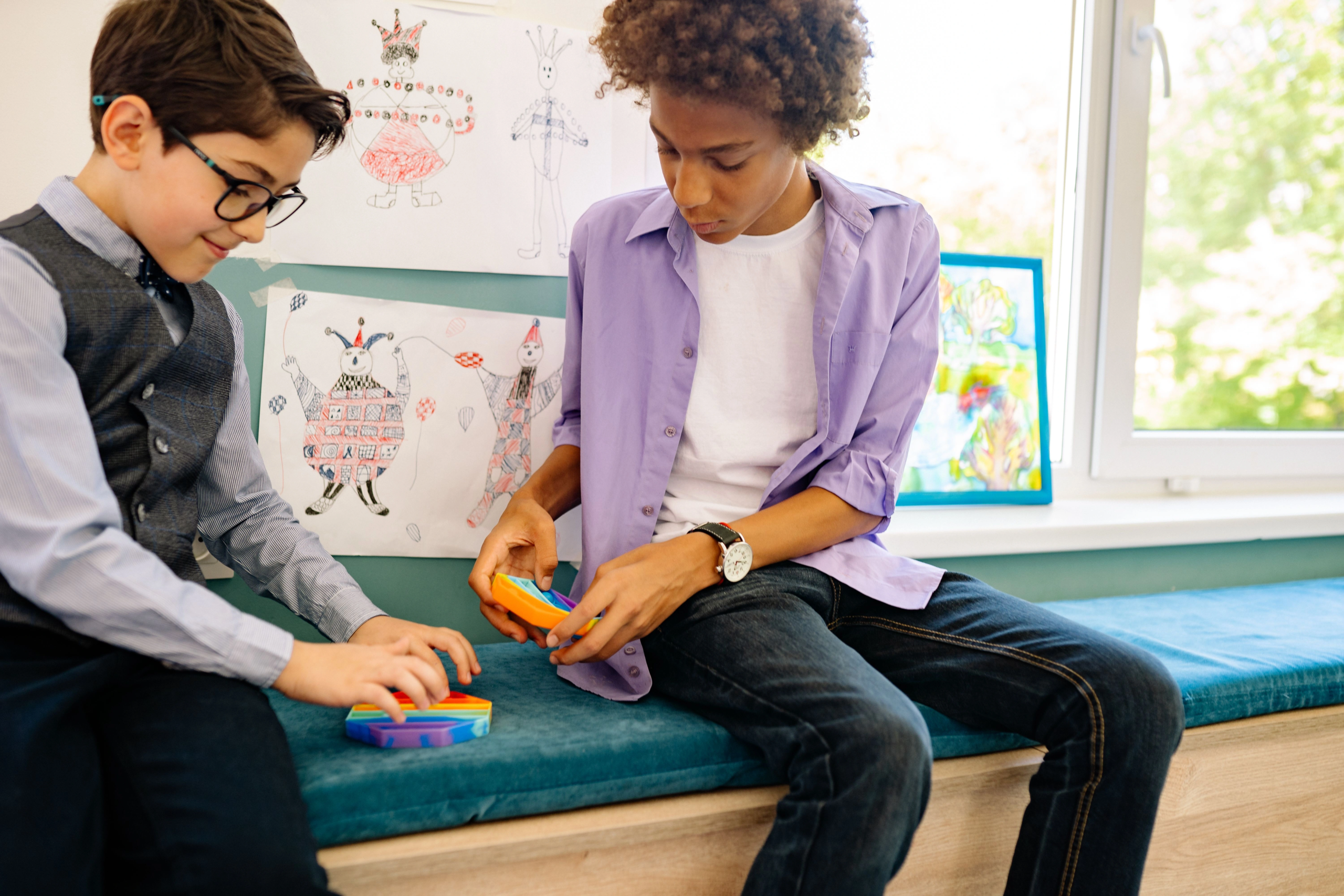
A teacher-approved fidget may also help a student self-regulate. Fidgets that click, flash, or make noise may be distracting, but quieter options can provide sensory input without disrupting instruction. For example, a textured sensory sticker can be placed on a notebook or desk and rubbed with a finger to provide a calming sensation. As with any classroom support, the teacher should approve the strategy and ensure it does not interfere with learning.

Collaborating with a child’s teacher to develop appropriate coping strategies can make self-regulation more manageable throughout the school day. When strategies are thoughtfully chosen to meet both the student’s needs and the classroom’s expectations, they can support the child’s well-being while contributing to a positive learning environment for everyone.

Holly Walther, MSW, LSW, is a Youth First Mental Health Professional at Holy Redeemer Catholic School in Vanderburgh County. Youth First, Inc., is a nonprofit dedicated to strengthening youth and families. Youth First provides over 100 highly trained mental health professionals (primarily master’s level social workers), prevention programs, parent engagement coordinators, and bilingual support personnel to 138 schools across 15 Indiana counties. Over 56,000 youth and families each year are served by Youth First’s school-based social work and community programs that promote mental health, prevent substance misuse, and maximize student success. To learn more about Youth First, visit youthfirstinc.org or call 812-421-8336.

August 19, 2026/by Youth First
https://youthfirstinc.org/wp-content/uploads/2026/08/Boys-with-popper-fidgets-scaled.webp 1707 2560 Youth First https://youthfirstinc.org/wp-content/uploads/2017/06/340x156_YouthFirst_logo_color-300x138.png Youth First2026-08-19 10:36:542026-08-19 10:36:54Coping Strategies That are (Almost) Too Cool for School

Helping Children Build Motivation: Small Steps Toward Success

All Posts, Counties, Youth First Blog

By Hannah Boutkan, MSW, LSW – August 13, 2026 –

Children are born with an innate desire to learn, grow, and explore the world around them. As they get older, however, environmental, social, mental, and emotional factors can affect that motivation, especially when it comes to school and everyday responsibilities. While adults cannot force a child to be motivated, they can create environments that encourage curiosity, confidence, and a willingness to keep trying.

The Harvard Center on the Developing Child offers several strategies to help build motivation, beginning in infancy.

One of the simplest ways to build connection and encourage curiosity is to follow a child’s lead. Take an interest in what captures their attention and encourage them to explore. When children feel supported in their play and discoveries, they learn that their interests and ideas matter. This early curiosity can become the foundation for a lifelong desire to learn.

Another valuable strategy is to encourage unstructured play. When children have opportunities to play without every activity being directed by an adult, they can develop imagination, creativity, problem-solving, and social skills. These skills become important later when children encounter challenging or less-interesting tasks. The ability to think creatively, solve problems, and interact with others can help them remain engaged when things become difficult.

It is also important to make sure expectations are age-appropriate. Think of the Goldilocks principle: a task should not be too hard or too easy — it should be just right. If a child believes a task is impossible, they may quickly become frustrated and give up. On the other hand, a task that is too easy may not provide enough challenge to hold their attention. The right level of challenge allows children to see a task as achievable while still giving them a reason to stay engaged.

Goal setting can also strengthen motivation. Goals give children a sense of purpose and help them understand why their daily responsibilities matter. One approach commonly used in social work is SMART goals: goals that are specific, measurable, achievable, realistic, and time-bound. Most importantly, goals should be meaningful to the child. When children have a voice in what they want to accomplish, they are more likely to see the goal as worthwhile and stay motivated to reach it.

Finally, adults should praise the process, not just the outcome. Recognize the small steps a child takes toward success: starting a difficult task, asking for help, practicing a new skill, or trying again after making a mistake. Focusing on effort and progress helps children understand that setbacks do not mean failure. Instead, mistakes become opportunities to learn and try again.

Motivation does not develop overnight. It grows through positive relationships, meaningful challenges, opportunities to explore, and encouragement along the way. By following children’s interests, encouraging play, setting appropriate goals, and celebrating progress, parents and teachers can create supportive environments that help children develop the confidence and motivation they need to succeed in the classroom and beyond.

Hannah Boutkan, MSW, LSW, is a Youth First Mental Health Professional at Holy Rosary Catholic School in Vanderburgh County. Youth First, Inc., is a nonprofit dedicated to strengthening youth and families. Youth First provides over 100 highly trained mental health professionals (primarily master’s level social workers), prevention programs, parent engagement coordinators, and bilingual support personnel to 138 schools across 15 Indiana counties. Over 56,000 youth and families each year are served by Youth First’s school-based social work and community programs that promote mental health, prevent substance misuse, and maximize student success. To learn more about Youth First, visit youthfirstinc.org or call 812-421-8336.

August 13, 2026/by Youth First
https://youthfirstinc.org/wp-content/uploads/2026/08/Adult-male-motivating-boy-scaled.webp 1707 2560 Youth First https://youthfirstinc.org/wp-content/uploads/2017/06/340x156_YouthFirst_logo_color-300x138.png Youth First2026-08-13 11:21:202026-08-13 11:21:20Helping Children Build Motivation: Small Steps Toward Success

You Can Help Students Feel Safe During Unpredictable Weather

All Posts, Counties, Youth First Blog

By Missy Johnson, MSW, LCSW – August 5, 2026 –

Last spring, as a Youth First Mental Health Professional working in several schools, I received several referrals to support students – of all ages – who felt nervous and worried about storms. Weather events like tornadoes, strong winds, and heavy rain can be very scary for kids, especially after hearing sirens or seeing and hearing about storm damage on the news.

As weather patterns become more unpredictable, damaging tornadoes and other severe storms are an increasing concern in Indiana. According to the Indiana Department of Homeland Security and the National Weather Service, Indiana averages about 22 tornadoes each year and has recorded over 1,500 tornadoes since 1950, resulting in thousands of injuries and many lives lost. This can increase anxiety for youth and their families.

Many students I supported last year shared common anxiety symptoms related to storms, including racing thoughts, fast heartbeat, stomachaches, trouble sleeping, fear of being separated from their families or caregivers, and difficulty focusing. Most students openly shared that they became immediately upset and fearful if they heard storm sirens or even heard someone say the word “tornado.” Even if there was no immediate weather danger, students openly reported that their bodies and minds remained on “high alert” after severe storms caused damage in and around the Tri-State area last year.

These reactions reported by students match what many youth experts describe as anxiety in children, where fear shows up in both the body and the mind. Anxiety related to storms can make some youth feel unsafe when they are away from parents or caregivers. They may need constant reassurance from trusted adults that they are safe.

Weather-related anxiety can also affect students academically. When children are worried about their own safety or that of their loved ones, it becomes harder to pay attention, remember lessons, or complete schoolwork. Some students struggle more on test days or during group activities when storms are predicted. Over time, ongoing stress can interfere with learning and classroom engagement.

Parents and caregivers play an important role in how children react to storms. While adults want to keep kids safe, repeatedly checking the weather on their phones or on the news, talking about worst-case scenarios, or showing visible fear can significantly increase a child’s anxiety. According to research by Katie A. McLaughlin, children tend to feel more distressed when their caregivers also show high levels of worry during or after severe weather events. Adults should keep in mind that children are always watching.

Social media can also raise anxiety. While it is sometimes hard to avoid constant exposure to weather-related alerts or notifications, dramatic images and nonstop coverage can make storms (or threats of potential storms) feel overwhelming. Limiting children’s access to news and offering calm, age-appropriate explanations can help reduce fear.

Another helpful way for families and schools to support students is to have a clear emergency plan for inclement weather and review it regularly. Knowing where to go, what alerts mean, and what steps to follow helps children feel more prepared, in control, and safe.

Creating a safe space for emergencies can also make a big difference. Along with usual safety items like flashlights, a radio, water, and batteries, families can include books, card games, board games, favorite stuffed animals, headphones, and snacks. These comforting items not only distract kids (and adults) but also help calm their bodies and remind them they are safe. Limiting time spent checking weather alerts, along with playing games, listening to music, or reading together, can help make stressful moments during unpredictable weather feel more manageable.

By staying calm, planning, and teaching healthy coping skills, families and schools can help students feel safer, more confident, and ready to learn—even during stormy weather.

Missy Johnson, MSW, LCSW, CTRS, is a Youth First Mental Health Professional at North Posey Jr High and North Posey High School in Posey County. Youth First, Inc., is a nonprofit dedicated to strengthening youth and families. Youth First provides over 100 highly trained mental health professionals (primarily master’s level social workers), prevention programs, parent engagement coordinators, and bilingual support personnel to 130 schools across 15 Indiana counties. Over 55,000 youth and families each year are served by Youth First’s school-based social work and community programs that promote mental health, prevent substance misuse, and maximize student success. To learn more about Youth First, visit youthfirstinc.org or call 812-421-8336.

August 5, 2026/by Youth First
https://youthfirstinc.org/wp-content/uploads/2026/08/Child-afraid-of-storm-scaled.jpg 1709 2560 Youth First https://youthfirstinc.org/wp-content/uploads/2017/06/340x156_YouthFirst_logo_color-300x138.png Youth First2026-08-05 10:42:322026-08-05 10:42:32You Can Help Students Feel Safe During Unpredictable Weather
Search Search

Topics

  • Caring for Your Own Mental Health is Part of Caring for Your ChildSeptember 9, 2026 - 4:04 pm
  • How Social Isolation Impacts Emotional Regulation in Young ChildrenSeptember 2, 2026 - 3:10 pm
  • Managing Stress in the Elementary ClassroomAugust 26, 2026 - 2:48 pm
  • Coping Strategies That are (Almost) Too Cool for SchoolAugust 19, 2026 - 10:36 am
  • Helping Children Build Motivation: Small Steps Toward SuccessAugust 13, 2026 - 11:21 am

Support Youth First

Help protect and heal the hearts of children by supporting Youth First!

Donate

Where to find us

111 SE Third Street, Suite 405
Evansville, IN 47708

Mon–Fri: 8:00–5:00
Sat–Sun: Closed

Get In Touch

812-421-8336

Contact
Copyright © 2026 Youth First, Inc. | Website by Media Mix
  • Website designed by Media Mix Advertising
  • Privacy Policy
Scroll to top Scroll to top Scroll to top