• Español Familias
Youth First
  • About
    • Who We Are
      • Mission, Vision & Values
      • Outcomes & Impact
      • Stories of Change
      • History
      • Staff
      • Youth First Mental Health Professionals
      • Board of Directors
      • Leading Sponsors
      • Careers
    • Where We Are
      • Catholic Diocese of Evansville
      • Daviess
      • Dubois
      • Gibson
      • Greene
      • Knox
      • Lawrence
      • Martin
      • Morgan
      • Orange
      • Perry
      • Posey
      • Spencer
      • Vanderburgh
      • Warrick
  • Programs
    • For Schools & Students
      • Youth First Mental Health Professionals
      • Al’s Pals
      • C.A.S.T.
      • LifeSkills Training
      • Reconnecting Youth
      • Teen Series
      • Tween Series
      • WhyTry
    • For Families & Youth
      • Camp Memories
      • Family First
      • Family First Foundations
      • In It to Win It
    • For Communities
      • Talk – They Hear You
      • The Truth Is
  • Resources
    • Resiliency Resources
    • Advice from Our Professionals
    • Other Helpful Resources
  • News
    • Newsletter
    • News Releases
  • Events
    • Calendar of Events/Programs
    • Youth First Warrick County Golf Scramble
    • Youth First Breakfast of Champions
    • Youth First Benefit Auction
  • Careers
  • Contact
  • Support
    • Donate
    • Volunteer
  • Click to open the search input field Click to open the search input field Search
  • Menu Menu
  • Link to Facebook
  • Link to Instagram
  • Link to Youtube
  • Link to LinkedIn

Tag Archive for: Chasidy Lambert

Teenage Attitude – What’s Under the Surface?

All Posts, Counties, Youth First Blog

By Chasidy Lambert, MSW, LSW – April 8, 2026 –

Adolescence is a time often marked by mood swings, intense emotions, and confusion. Stress, anxiety, and even depression can feel like constant companions. Anyone who has lived with, taught, or even briefly interacted with a teenager knows that something powerful is happening beneath the surface, and it’s far more than just “attitude.”

Teenagers are navigating a complex mix of hormonal changes and rapid development, all while trying to understand themselves and the world around them. Even when it may seem like they’re not trying, they are often doing the best they can to keep up.

These changes are needed for development and growth, not just physically, but emotionally. Hormones act as chemical messengers, sending signals throughout the body and brain. At times, those messages can feel contradictory, blurring the lines between “grow stronger” and “feel deeply uncertain.”

While hormones are doing exactly what they’re meant to do, they can also create turbulence in a teen’s mood. During adolescence, it’s as if the brain turns the hormone faucet on full blast, and sometimes the handle comes off entirely. The result isn’t a problem to fix, but a perfectly normal teen who often feels out of control.

During adolescence, a teen’s brain is reshaped, with neurons and synapses constantly reorganizing. Some connections are strengthened while others are pruned away to make the system more efficient. This helps explain why a teen’s decision-making can look so different from an adult’s. Their brains are still under construction, especially in areas responsible for judgment, impulse control, and long-term thinking. 

Puberty triggers the release of estrogen, progesterone, and testosterone, the sex hormones that drive the visible changes we often focus on, like growth spurts, voice changes, acne, and body development. What’s discussed far less is how these same hormones hijack emotions, decision-making, sleep patterns, and self-esteem. When adults understand this fuller picture, it becomes much easier to support teens as they navigate the challenges of everyday life.  

If you’ve seen the movie Inside Out, you’ve already caught a glimpse of how a young brain adapts to change. In real life, the limbic system – the part of the brain that drives emotions – develops earlier than the prefrontal cortex, which is responsible for impulse control, planning, and logical thinking. Teens often feel things deeply and intensely before they can fully reason through those feelings. It’s like having a racecar engine paired with bicycle brakes. Hormones add even more fuel to the engine, and suddenly everything can feel loud, fast, and overwhelming.

This is why a teen can go from laughing to sobbing in a matter of minutes. It’s why a missing hoodie can feel like a full-blown crisis, and why “I’m fine” so often means the opposite. Hormones don’t just influence emotions; they amplify them, making joy feel euphoric and disappointment feel overwhelming. When adults respond with phrases like “you’re overreacting,” they miss the mark. From a teen’s perspective, those feelings are very real and deeply felt. Kids need guidance and support in these moments. 

Other common changes include risk-taking, poor impulse control, pushing boundaries, and shifts in sleep patterns. Hormones also influence how teens see themselves and how they believe others see them. Body changes can cause intense self-consciousness. A single comment about appearance can echo for years. Hormonal shifts also interact with mental health, sometimes intensifying anxiety, depression, or irritability. For teens already navigating trauma, stress, or unstable environments, hormones can magnify everything they’re carrying.

So, what helps? First, adults need to pause and remember that this phase is temporary, even when it feels endless. Validation is important. Saying “that sounds really hard” goes further than “you’ll get over it.” Consistent boundaries, when paired with genuine empathy, create a sense of safety. Teens still need structure, even when they loudly insist that they don’t. This is where many parents struggle: finding the balance between firmness and understanding. A helpful place to start is by asking, “What are my boundaries? Am I responding with empathy to what they’re experiencing?”

Education is powerful. Teens deserve to know what’s happening with their bodies, and knowing that hormones are shaping their reactions can be incredibly empowering. Humor can help, too. Try something like, “Your brain is running a software update right now, and it’s a little glitchy.” Teens get that.

Hormones don’t make teenagers impossible; rather, they make them human while navigating one of the most confusing and tender stages of life. Beneath the mood swings, eye rolls, and dramatic sighs are young people trying to understand who they are while their bodies rewrite the rules almost daily. They’re not giving us a hard time – they’re having a hard time. And honestly? Considering everything they’re juggling, they’re doing remarkably well.

Chasidy Lambert, MSW, LSW, is a Youth First Mental Health Professional at Castle High School in Warrick County. Youth First, Inc., is a nonprofit dedicated to strengthening youth and families. Youth First provides over 100 highly trained mental health professionals (primarily master’s level social workers), prevention programs, parent engagement coordinators, and bilingual support personnel to 130 schools across 14 Indiana counties. Over 55,000 youth and families each year are served by Youth First’s school-based social work and community programs that promote mental health, prevent substance misuse, and maximize student success. To learn more about Youth First, visit youthfirstinc.org or call 812-421-8336.
April 8, 2026/by Youth First
https://youthfirstinc.org/wp-content/uploads/2026/04/Sad-teen-girl-scaled.jpg 1702 2560 Youth First https://youthfirstinc.org/wp-content/uploads/2017/06/340x156_YouthFirst_logo_color-300x138.png Youth First2026-04-08 15:00:592026-04-08 15:01:01Teenage Attitude – What’s Under the Surface?

From a Pen to a Boat: How a Local High School Senior Raised $2,000 for Youth First

All Posts, Counties, Stories of Change, Youth First Blog

By Julie Hoon, VP of Marketing & Communications – December 4, 2025 –

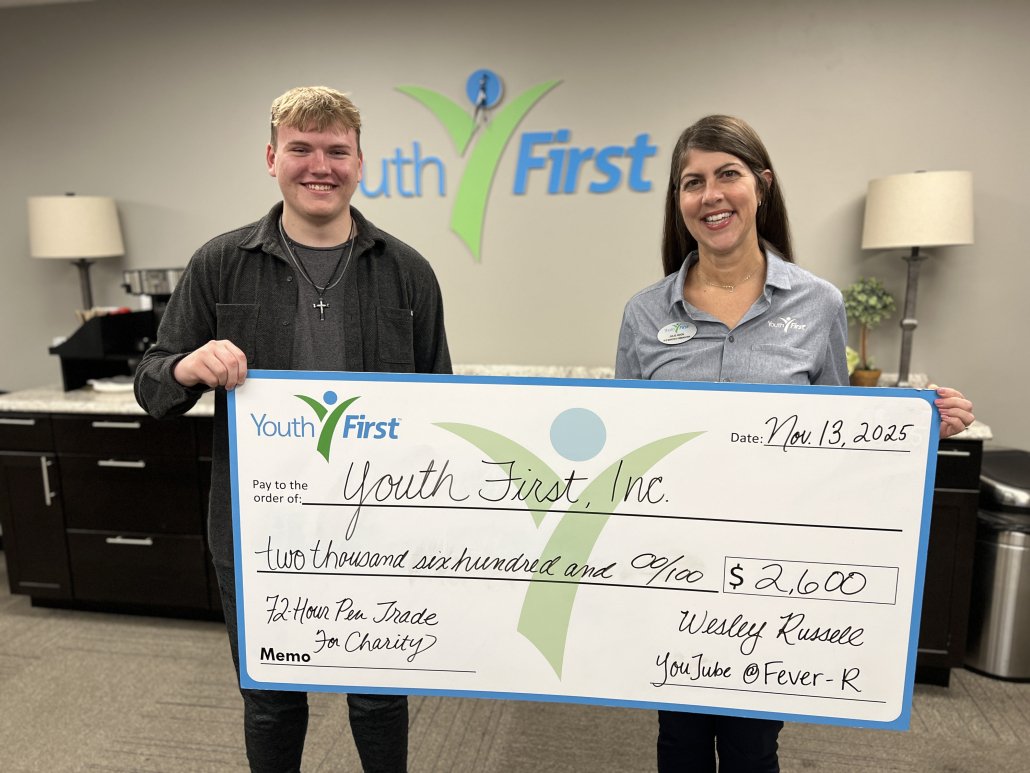
Eighteen-year-old high school senior Wesley never expected that starting with a simple pen would lead to a $2,600 donation to Youth First. After launching a 72-hour challenge on his YouTube channel, he selected Youth First as the recipient of whatever funds he could raise through a creative trading mission. His effort quickly gained the attention of his family, friends, and his Youth First Mental Health Professional at Castle High School, Chasidy Lambert.

“He’s a student with a vision!” Lambert said. “I don’t know many people who could turn a pen into a boat… just by asking! I’m so proud of the growth I’ve seen in him. He’s made big steps in connecting with people and in his demeanor and responsibilities. He pushes himself to maintain a healthier mindset and form healthy relationships. Seeing him use his skills to achieve a fundraiser like this for Youth First is amazing.”

Wesley started his YouTube channel as a way to push himself beyond his social anxiety. Wanting to use the platform for something positive, he came up with the idea of trading a pen up to a high-value item, then donating the proceeds to a local nonprofit. To hold himself accountable, he set a 72-hour limit and created the challenge: “72-Hours to Trade a Pen for Charity.” With a friend filming, he committed to three days of trading, ending with whatever item he secured at the final deadline.

On day one, Wesley made his first trade when a couple swapped his pen for a Mother’s Day decoration. That small success fueled a huge second trade: a propane grill. Although the ignitor didn’t work, the grill could still be lit manually.

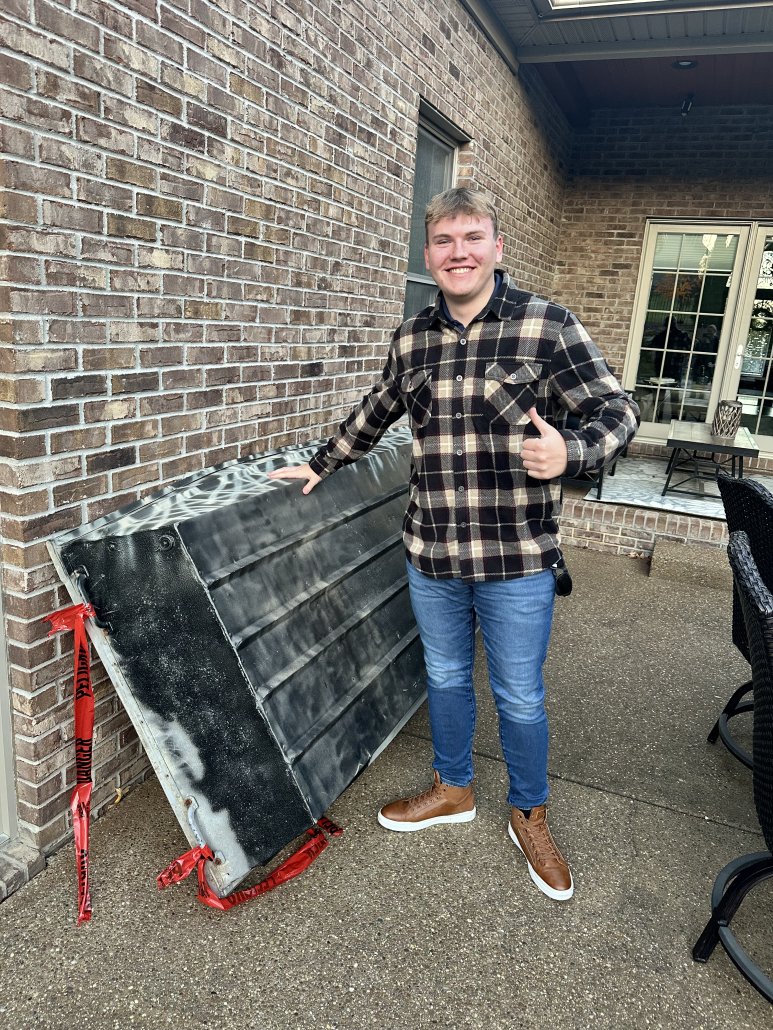
Day two brought another surprising turn. An individual offered to trade a subwoofer and amplifier for the grill. By the end of the day, Wesley and his friend decided to broaden their reach, posting the available items on Facebook Marketplace and Snapchat. Their social media outreach paid off; by day three, Wesley received an offer to trade the subwoofer and amplifier for a 12-foot jon boat—a flat-bottomed, lightweight fishing boat. After securing a truck to transport it, the trade was finalized.

Later that same day, Wesley found a buyer for the boat and announced that his chosen charity was Youth First. When the buyer learned the proceeds were being donated, he increased his offer to $1,500. Additional contributions from family and friends who followed the challenge brought Wesley’s total donation to an impressive $2,600.

“I’ve never seen anything like this!” said Julie Hoon, Youth First’s Vice President of Marketing & Communications. “Our donors are incredible and come in all ages and stages of life, but not many can say they turned a pen into $2,000. Wesley’s heart is big, and I’m so impressed with his charitable mindset. I hope he motivates other young people to see how one idea can support a mission and make a substantial impact.”

When asked why he chose Youth First, Wesley explained, “Other people need this money more than me. I wanted it to go to an organization that has helped me, and that’s Youth First. I want to make sure they’re always able to help students.”

If you are inspired by Wesley’s story and would like to consider a donation to Youth First this holiday season, please visit our website at youthfirstinc.org/donate. Write “Wesley’s Story” in the comment box.

To visit Wesley’s YouTube channel, Fever-R, and watch this story, click here: I Turned a Pen Into $2000 for Charity.

December 4, 2025/by Youth First
https://youthfirstinc.org/wp-content/uploads/2025/12/Wesley-Big-Check-Photo-2925-scaled.jpg 1920 2560 Youth First https://youthfirstinc.org/wp-content/uploads/2017/06/340x156_YouthFirst_logo_color-300x138.png Youth First2025-12-04 10:09:322025-12-04 11:30:12From a Pen to a Boat: How a Local High School Senior Raised $2,000 for Youth First

The Art of Being Still

All Posts, Counties, Youth First Blog

By Chasidy Lambert, MSW, LSW – June 26, 2024 –

Life is busy! We’re managing so much in our daily lives to stay on top of things: jobs, kids, school, sports, other extracurricular activities, community projects, relationships with family and friends, staying healthy, managing finances…the list goes on and on. Getting all of these boxes checked can feel like a second job in itself. 

Our lives are buzzing as we attempt to make everything happen at once. It’s no wonder we are seeing the rise of young families moving away from the “city life dream” their parents once had to a minimalistic world view – a quieter life with activities like growing their own garden, decluttering, canning food, and other ways to escape the “chaos” and be more self-sufficient. 

Though escapism is not always healthy, we can appreciate the lost art of living a less stressful life by resting in our current reality. One way we can experience this stillness is through practicing mindfulness. Mindfulness is a skill often used in meditation.

To practice mindfulness, you focus on the present without fear of the future or dwelling in the past. There are different ways to be mindful, but the gist of it is being completely in the moment without any distracting thoughts. Mindfulness is a great skill for all ages to learn.

Studies have shown that mindfulness helps children develop skills such as self-control and stress management. It helps adults reduce stress and learn to enjoy even the small moments. When families combine their individual practices of mindfulness, they are able to make more meaningful connections together. Though being still in the hustle and buzz is often hard, utilizing mindfulness can be a simple yet effective way to reset our minds and bodies.

One activity I would suggest is gratitude mapping. You begin by taking a breath, being mindful of all the things in your life you are thankful for, and then writing a list of those things. This activity shifts the focus to a more positive mindset, which results in fostering kindness in our interactions.

Another activity you can try as a family is mindful listening. There are so many ways to do this, but the easiest one is going outside and closing your eyes. What do you hear? Pay attention to the birds, wind, and other outside noises. You can take it a step further and notice the grass under your feet or the wind or sun on your face. You can also use calming music for this activity.

Breathing, movement, and growth are basic human functions needed to live a purposeful life. To achieve the art of being still, we can utilize our mindfulness skills to reset our bodies and remind ourselves that our “to-do” lists and events are not what define us. Rather, it is the interactions we have with those around us.

June 26, 2024/by Youth First
https://youthfirstinc.org/wp-content/uploads/2024/06/Asian-woman-outdoors-with-coffee-scaled.jpg 1707 2560 Youth First https://youthfirstinc.org/wp-content/uploads/2017/06/340x156_YouthFirst_logo_color-300x138.png Youth First2024-06-26 15:12:312024-06-26 15:12:32The Art of Being Still
Search Search

Topics

  • Youth First to Honor Carol Lynch as 2026 Dr. William Wooten ChampionJuly 23, 2026 - 3:11 pm
  • How to Help Your Kids Make Good DecisionsJuly 22, 2026 - 2:22 pm
  • Youth First Receives $40,000 Award from CenterPoint Energy FoundationJuly 16, 2026 - 9:34 am
  • Establishing a Smooth Transition from Home to SchoolJuly 15, 2026 - 2:16 pm
  • Promoting Patience in a Fast-Moving WorldJuly 8, 2026 - 2:33 pm

Support Youth First

Help protect and heal the hearts of children by supporting Youth First!

Donate

Where to find us

111 SE Third Street, Suite 405
Evansville, IN 47708

Mon–Fri: 8:00–5:00
Sat–Sun: Closed

Get In Touch

812-421-8336

Contact
Copyright © 2026 Youth First, Inc. | Website by Media Mix
  • Website designed by Media Mix Advertising
  • Privacy Policy
Scroll to top Scroll to top Scroll to top